Product Specifications
| Markets: |
North America,South America,Eastern Europe,Southeast Asia,Africa,Oceania,Mid East,Eastern Asia,Western Europe |
| Materials: |
Bk7/K9, Fused Silica, Sapphire, Znse, etc |
| Dimension: |
5mm-400mm |
| Dimension Tolerance: |
+/-0.1mm |
| Surface Quality: |
10/5, 20/10, 40/20, 60/40 |
| Surface Accuracy: |
Lambda/4(High Precision) |
| Centration: |
5 Arc Minutes |
| Clear Aperture: |
>90% |
| Coatings: |
Hr, Ar Upon Customers Requirements |
| Bevels: |
Protective Bevels by 45deg*0.25mm |
| Type: |
Convex Lens |
| Shape: |
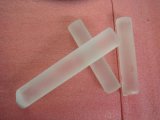
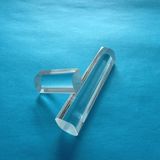
Cylindrical Shaped Lens |
| Material: |
Optical Glass |
Product Description
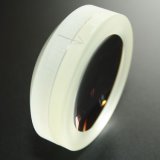
High precision Aspheric lens
An aspheric lens or asphere is a lens whose surface profiles are not portions of a sphere or cylinder. In photography, a lens assembly that includes an aspheric element is often called an aspherical lens.
The asphere's more complex surface profile can reduce or eliminate spherical aberration and also reduce other optical aberrations compared to a simple lens. A single aspheric lens can often replace a much more complex multi-lens system. The resulting device is smaller and lighter, and sometimes cheaper than the multi-lens design. Aspheric elements are used in the design of multi-element wide-angle and fast normal lenses to reduce aberrations.
Aspheric Lenses are used to eliminate spherical aberration in a range of applications, including bar code scanners, laser diode collimation, or OEM or R&D integration. Aspheric lenses utilize a single element design which helps minimize the number of lenses found in multi-lens optical assemblies. Said another way, unlike conventional lenses with a spherical front surface, aspheric lenses have a more complex front surface that gradually changes in curvature from the center of the lens out of the edge of the lens. This reduction in total element count not only helps decrease system size or weight, but also simplifies the assembly process. Integrating aspheres into an application such as focusing the output of a laser diode may not only decrease total cost, but may also outperform assemblies designed with traditional spherical optical lenses.
Parameters
| 1.Materials | BK7/K9, fused silica, sapphire, ZnSe, etc |
| 2. Dimension | 0.5mm-400mm |
| 3.Surface quality | 10/5, 20/10, 40/20, 60/40 |
| 4.Focal length tolerance | ±1% |
| 5.Length tolerance | ±0.1mm |
| 6.Width tolerance | ±0.1mm |
| 7.Center thickness tolerance | ±0.1mm |
| 8.Centration | 5 arc minutes |
| 9.Surface precision | 0.5 fringes/cm |
| 10.Clear aperture | >90% |
| 12.Coating | HR, AR |
| 13.Bevels | Protective bevels by 45deg*0.25mm |
Advantages Over Spherical Lenses
Aspheric lenses are built to be cheaper and smaller than conventional lenses, and they often surpass the quality of lenses made from a spherical shape. Thanks to their manufacturing process, aspheric lenses are in continual improvement as technology moves forward.
Specifications
1. High accuracy
2. Competitive price
3. Fast lead time
4. IR aspheric lens
Since its inception, Jiahong Optics has been involved in the design, research and development of precision optical components, thin film coating and in related instrumentation activities. Close cooperated with universities, institutes, some industrial firms and national aero-space project. We will be happy to quote for all custom optics.
While our company is young, our proved successful experience is the core to our success. We have the capabilities to offer a very wide range of custom optics and precision optical components.
With our expanding international network, we can satisfy any customer requirements and be responsive to your exact needs before and after delivery. Our commitment is to consistently provide you with high qualtiy products and services designed to your exact specifications delivered on time at a competitive price.
We are happy to undertake projects of all sizes-from one-off research orders to large scale production runs with call off delivery schedules.