Product Specifications
| Markets: |
North America,South America,Eastern Europe,Southeast Asia,Africa,Oceania,Mid East,Eastern Asia,Western Europe |
| Usage: |
Bird |
Product Description
EI-WL2/X Feeding system
(Including feed supply system)
Users' Manual
Qingdao Xingyi Electronic Equipment Co., Ltd
Forewords
Thank you for your choice of EI-WL2/X Feeding System made by 41st Institute of China Electronic Technology Group Corporation (CETC) and Qingdao Xingyi Electronic Equipment Co., Ltd. The products from our institute are featuring high, sophisticated and world-leading technology and manufactured in accordance with ISO9000 Standards. All of our work is aiming at the product quality and demands of our customers.
The manual is designed to provide information about the application, performance, features, basic working principles, installation methods and notice items for EI-WL2/X Feeding System, so as to help you familiarize with installation and operation of the system ASAP. Read this manual carefully to implement installation in the correct way.
We consider it our duty to meet your demands and provide high quality breeding accessories and after-sales service to you. Our concept is "Good Quality, All-Round Service" and our promise is Satisfactory Products and Service.
You are welcome to contact us for any information via the following ways:
Content
Chapter I Introduction ----------------------------------------------------------------------------------1
Section I Users' Guide ----------------------------------------------------------------------------------2
Chapter II Users' Guide --------------------------------------------------------------------------------3
Section II Specification---------------------------------------------------------------------------------13
Chapter III Specification -------------------------------------------------------------------------------14
Section III Maintaining Guide ------------------------------------------------------------------------15
Chapter IV Maintaining Guide ------------------------------------------------------------------------16
Chapter I Introduction
1. Brief
EI-WL2/X Feeding System is an automatic poultry house feeding system developed by 41st Institution of CETC and its Qingdao XingYi Electronic Equipment Co.,Ltd., taking its technical advantages, integrating China domestic poultry fostering practices.
EI-WL/X Feeding system is divided into EI-WL1/X breeders feeding system, EI-WL2/X broiler feeding system. There EI-WL2/14 round feeding pan and EI-WL2/14.2 broiler feeding pan as options for customers, designing specially for high-level poultry house. The EI-WL2/X feeding system can make full use of room inside the poultry house, making each bird in the house get feed within the shortest period. The system is top choice for modern and scaled poultry -fostering.
We hope our Institution and correspondent enterprise can facilitate your works, boost your benefits. It is welcomed to contact us.
This manual suits for raising broilers and the male breeders.
2. Security Notes
a. Feeds conveyed by system can not have metal, fabric and other sundries, avoiding to damage auger and to block feeding pipes.
b. Except maintaining, it is prohibited to open cover on the boot of hopper and cover on the motor assembly box.
c. On maintaining, the power for control cabinet must be switch off.
d. The grounding wire must be connected with the grounding screws on the control cabinet reliably, ensuring personnel's safe.
e. Working conditions for feeding control cabinet should comply with requirements.
f. Keep hygiene for feeding lines control cabinet.
g. Load for Each electric circle is prohibited to exceed rated power.
h. Check wire-connecting conditions regularly.
i. Feeding lines control cabinet should avoid mechanical oscillating, colliding, falling and other mechanical damages.
j. The main power must switch off when the control cabinet is out of usage.
3. About this manual
This manual is divided into 5 parts:
Chapter I Brief: Introducing EI-WL2/X feeding system in terms of its usage and security notes.
Section I Users Guide
Chapter II Users Guide: Introducing using methods for EI-WL2/X feeding system and its parts.
Section II Specification
Chapter III Specification: introducing the working conditions which make full use advantages of EI-WL2/X feeding system, work principles and technical specifications.
Section III Maintaining Guide
Chapter IV Maintaining Guide: introducing EI-WL2/X feeding system in terms of maintaining, simple trouble-shootings.
Chapter I
Users' Guide
Section II Users Guide
1. Inspection before using
a. Checking if the parts, like driving system, hopper, feeding pipe and feeding pan and etc, are assembled correctly, and the feeding line is flat.
b. Checking if each of fixing screws and nuts is reliable.
c. Connecting terminals conditions: if it is fixed and reliable and screw up the loosen parts of terminals.
d. Ensuring personnel safety, the grounding wire must connect reliably with grounding screws on the control cabinet.
e. Feeding lines get electrified to check operating conditions, running without load for 1-2 min. while it runs without load, push the feed lack switch by hands otherwise the driving motors for feeding lines dose not work. Ensuring the revolving direction of motors is correct before usage. See more at 3.4.
2. Layout for poultry house
Under the normal conditions, given the length of poultry house is less than 120 m, there should be small hoppers at the end of the feeding lines insides the poultry house, and driving system & terminal feed pans for the other end. Given the width of poultry house is 12m, there should be 3 feeding lines while 4 lines for that of 16m width. Layout is for fig 2-1, electric wiring layout is for fig 2-2, and suspending system see fig 2-3, this layout is for reference only.
Fig 2-1 Layout for Feeding lines (3 feeding lines)
Fig 2-2 Layout for electric wiring (2 feeding & 1 supplying)
| No. | Description&Model | Remmarks |
| No. | Description&Model | Remmarks |
| 1 | Hopper and bottom | See details in fig. 2 and 3 |
| 11 | End pan | See details in fig. 6 |
| 2 | Anti-roost line bracket |
|
| 12 | Drive mechanism | See details in fig. 6 |
| 3 | Feed pan | See details in fig. 4 |
| 13 | pulley 1-7/8″ |
|
| 4 | Feed pipe, auger |
|
| 14 | Winch | See details in fig. 7 |
| 5 | Anti-roost line |
|
| 15 | enforced beam for Winch |
|
| 6 | Feed pipe clamp |
|
| 16 | pulley 3-1/2″ |
|
| 7 | Wire rope φ2.5 |
|
| 17 | Wire rope φ5 |
|
| 8 | Adjust plate |
|
| 18 | Wire rope φ2.5 |
|
| 9 | Feed line hook |
|
| 19 | Chain pulley |
|
| 10 | Detection pan | See details in fig. 5 |
| 20 | chain φ5 |
|
Fig 2-3 suspending system for feeding lines
3 Introduction
3.1 Using methods for feeding lines
3.1.1 Feeding lines' operation
1) At the beginning of brooding, it is common using only part of the poultry house to foster chicks; if this area is located at the middle of poultry house, using baffles to block feeding pans that locate out of this area and closer to the end of hopper (see Fig 2-5) to avoid waste resulted from feed drop; Keeping 3m away from the last chicks-fostering feed pan. The water-proof plugs on the detective feeding pan should connect with the closet water-proof socket.
2) At the beginning of brooding, chicks are relatively small so feeding pans should rest on the ground, lowering feeding lines till feeding pans on the ground when feed drop windows of feeding pans are fully opened. This time, feed will drop into feeding pan so that poultry are more convenient for find feed, adapt to feeding system and begin pecking. Ensuring all of feed windows at same position, no matter close or open. Although most weight of feeding lines will be taken by ground, the weight on the suspending system should not be removed, making hanging ropes droopy.
3) Starting feed supply system, feed begins to be conveyed feed for each small hopper; dumped into hopper manually without feed conveying system.
4) During the feed getting into hopper, feed supply system should be closed handily when the feed is up to 1/3 of capacity of each hopper.
5) Switching on feeding lines (turn knob in feed control cabinet to manual model, see more details on "the operation of feeding control cabinet")again and operating feed supply system manually, for reducing burden of feed supply motors, allowing hopper empty for 30 seconds between every 2 feed-adding, repeating this procedure until feed go into all feeding pans. When feed drop windows are open, do not turn system to auto mode (full speed), and feed manually instead.
6) The feeding lines can swift into auto-run status after it is full of feed.
7) When brood stage finished and need to lift feeding lines, people can use drive hooker turning winch round clock-wisely (the feeding line will go up if turn winch round anti-clock-wisely) until feeding pans at the proper height. Edge of pans should be around height of neck and chest of poultry. Proper feeding pan height will reduce feed waste, improve feed transform and bring more income for producers.
8) When lift feeding lines, feed pans will close feed drop window automatically.
9) "Proper height of feeding pan"+ "proper settings of feeding pan" + "correct time interval of feed supply", together those all will make best use of feeding system.
10) It is suggested that the feed drop windows should be open at the first 5-10 days for chicks.
11) One day prior to sale, pushing the feed lack detective switch inside hopper down by hand evacuates feed inside feeding pipes; let poultry eat up all of feed remaining in feeding pan, which can reduce waste for better effect.
12) When there is no poultry inside the house and disinfecting the house in washing, remove all of rest feed from feeding system and Switch off system power to avoid starting system unexpected as well as take good water-proof measures for electrical equipments like, water proof plugs, detective feed pans, detective switch in hopper and motors etc.
3.1.2 Notes:
1) Poultry will avoid dark area, do not put mobile detective feed pan in such an area, neither at the end of poultry house. The interval between Mobile detective feed pan and wall is at least 3 m. all of those issues should be avoided to greatest extent during installation; Artificial lighting can resolve part of those issues.
2) Within first 5 days of brood, feeding pans should be on the ground, operate system manually.
3) Starting feed convey system, or manual adding if without feed convey system, prior to operating feeding lines, putting feed into small hoppers. The feeding system works only when feed amount inside small hopper exceeded lowest feed volume (the feed lack switch is pressed on).
4) When feeding system running, people may need walking among feeding lines to drive flock of poultry that are rushing to feeding pans, avoiding poultry get crowd; or can lift feeding lines away poultry, fill feed then drop feed line carefully.
5) When poultry is for sale, rest feed contained in feed pipes, hopper and feeding pans should be removed. If possible, poultry should eat up rest feed before sale.
6) When feeding system lifts up to nearly away ground, there may be some places lower than others, where feeding pan will appear too high, blocking up the lower places.
7) When there is no poultry in the house or disinfecting house in washing, it is a must to remove all of feed from feeding system.
8) Removing feed inside feeding pipe into feeding pans before moving poultry out of house, poultry eat up feed in the pans.
9) If system does not work for long time, it should remove feed from hopper, feeding pipes and feeding pans; switch off power of system, avoiding start system accidently.
3.2 Basic operations of feeding pans
3.2.1 Assembling of feeding pans
When assembly feeding pans, first, turn adjust sleeve into housing; second, get hanging rack through adjust sleeve from inside to outside; then, make an angle between bottom pan and housing then connected buckles on bottom plate and on the housing; finally, fully fastening shell and bottom plate.
When assembly pans with feeding pipes, one feeding pan is under each square hole of feeding pipe. For round feeding pans, insert baffle on hanging rack in direction towards motors; for broilers feeding pans, insert baffle on the hanging rack in direction towards hoppers.
Two protuberances on the feeding pipe should aim at two long-round holes on the hanging racks, then push hanging cap in direction towards pipes into hanging rack, During the process, push two reeds handles on the hanging cap down; loosen the handle after reeds into hanging rack, keep going into slowly, reed will re-bound automatically after the hanging cap is at position.
After fixed feeding pans and feeding pipes, insert piece should be pushed into pans which need it. Insert pieces should be catalogued into 3 scales for needed, adjusting feed dropping speed.
Fig 2-5 EI-WL2/14 round feed pan sectional view
Fig 2-6 EI-WL2/14.2 broilers feed pan
sectional view
3.2.2 Basic Operation for EI-WL2/14 Round Feeder Pan
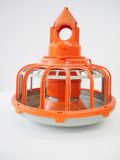
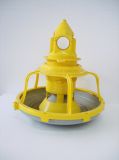
Developed by our Institute on ourselves, the EI-WL2/14 Round Feed Pan (see fig 2-5) and EI-WL2/14.2 broilers feed pan (see fig 2-6) provides up to 14 eating positions and suits chicks from one day old to grownup. It is easy to operate and maintain. Feeding pans can vary meeting different customers' demanding.
When during brooding, the feeding line is lowered so that the feed pans rest on the floor, until hanging Rack touching bottom, turning adjust sleeve, the pans' drop windows will be open completely, filling the pans with feed. In this way it is easy for the birds to find the feed, adapt to the pans and begin eating. Though most of the weight of the feed line is borne by the floor, do not remove all weights on the suspension system to make the suspension line sagging.
3.2.3 basic operation for breeding
When only part of the poultry house is used for brooding, those feed pans without chicks use provided insert pieces (refer to figure 2-5 and 2-6) to jam the drop tubes (the insert piece enters its full length). Such pans do not receive feed. They are closed. This helps save feed. When they are needed for use, pull out the insert piece two scales and the drop tube will be fully open. The feeder pans are providing full feed at this time. If the insert piece is only pulled out one scale, the drop tube only opens a half.
We recommend in the first few days, provide more feed to the young birds. This is especially necessary when only part of the poultry house is used for brooding.
When the feed windows are open, do not let the EI-WL2/X feeding system run automatically (maximum feed supply). It is recommended that in the first 5~10 days, open the drop windows at the side. Operating feed pans at least twice per day in the first 5 days is recommended and after that if the drop windows at both sides are open, operating feeding system at least three times per day. If you are unable to operate manually the feed line 1~3 times per day during the brooding period (drop windows are open), use the timer clock to limit the operation times and period of the feeding system. Failure to implement any of the above actions, the feed into feeder pans would be too much, causing waste.
Note:When drop windows are open, do not let the EI-WL1/X feeding system run automatically (full speed).
As the birds grow, they gradually become adapted to feeder pans and the feeding system would need to be lifted to the height of a grown-up bird. But before lifting the feeding system, we recommend you let the birds peck up the feed below the drop window. This helps the proper shutdown of the drop window.
Adjust the suspension system and lift the feeding line. When the feeding system is lifted, the drop windows at both sides would be closed. Continue lifting the feed line till the feed pans just leave the floor.
According to the growth stage of poultry and the size of the feed granule, turn the adjust sleeve (as shown in figure 2-5) to regulate the amount of the falling feed. There is a handle for adjustment purpose. Turn it counter-clockwise to widen the gap between the hopper and the bottom plate; turn it clockwise to decrease that gap. The specific figures are indicated by the arrow on the adjust sleeve.
3.3 Operation of Detection Feeder Pan
EI-WL2J/14 Round Detection Feeder Pan is used for the feed line with round feed pans.
During installation, place the detection pan at least 3m apart from the fatigue. When only part of the house is used for raising, the detection pan should be installed at least the space of two feed pans away from the raising curtain or isolation board, which enables birds to eat feed from it voluntarily.
In operating, insert water-proof plugs into closet water-proof socket, adjusting screws for regulating bottom height, making height of detecting feed pan as high as that of other feed pans.
Clear the control feed pan several times every day to make the feeding system work well. The feeding system would emit sounds to remind birds and adapt them to eating from pans in a shorter period.
Fig 2-7 detective feeding pan (with mechanical detective switch)
Fig 2-8 detective feeding pan (with reed switch detective switch)
No. | Description&Model | Remmarks |
| 1 | Butterfly nut |
|
| 2 | Test switch |
|
| 3 | Anti-roost pulley |
|
| 4 | Water proof socket |
|
3.4 Use of EI-WL2Q Driving Mechanism
The main part of the Driving Mechanism is the power part of feeding system. Pay attention to the turning direction of the motor when it is working. Seen from the axis to the motor, it turns counter-clockwise. To reverse the turning direction of the motor, change the phase sequence of the power cords in the motor terminal box or EI-1201 Feed Supply and Feeding Control Cabinet for Raising System. The end feeding pan of driving mechanism should be emptied several times everyday, ensuring feeding system work in order.
Note: the turning direction of motors are vital, it is a must making motors work without loads if changing motors or power cords, ensuring right turning direction of motors before operation.
3.5 Operation of Feed Supply system
3.5.1 Pre-selection for switch
After turn on the chief switch in the control cabinet, according to different needs, knobs can be turned at "start", "stop" and "auto" positions separately.
At the position of AUTO, control cabinet will receive controlling signals sent by "poultry house climate controller" and feed level detection switch, control status of motors of feed supply.
At position of "start",motors of supplying and feeding will always work unless the feed is full.
At position of "stop", all of feed supply circuits will stop working.
Either at position of "auto" or "start" motors of feed supply and feeding will be subject to feed detective switch. When feed level in hopper and feeding pans reach setting positions, motors will stop working automatically.
Feed supply control circuit has feed-lack protection function for main hopper and feed supply auger safety protection function: when main hopper lacks feed, motor stop working; also, when feed-supply mechanism is full of feed, protection switch works, motor stop working.
3.5.2 Adjusting speed of feed-drop
By changing baffle' position on 3-way sub-assembly, size of feed-drop will be changed, regulating speed of feed-drop. After the baffle changed," location reed" will work along with "location slot" to ensure baffle moving little.
Adjusting feed-drop speed at every feed-drop pipes ensures the speed change from big into small, from the hopper side, namely the hopper that is closet to drive mechanism will be fulfilled at last.
| No. | Description&Model | Remmarks |
| 1 | Adjust line |
|
| 2 | baffle |
|
| 3 | housing |
|
| 4 | screw |
|
Fig 2-9 Adjusting speed of feed drop
3.6 Operation of EI-LK2 feeding control cabinet
3.6.1 Voltage measuring
Before turning on power switch inside control cabinet, turn knobs on panel into position of "stop", and measure voltage value at the power side of power switch, turn on power switch after the voltage ensured within 380/220VAC±10%;
3.6.2 Pre-selection for Switch
After the chief power switch inside control cabinet is turned on, turn knobs at positions of "manual", "auto" or "stop". When knob is at "manual", driving motors will be always at working conditions when there is feed in the hopper, which will stop when the detective feeding pan is full. This feeding circuit will stop working when knob turned on "stop".
When auto-feeding is needed, turn knob on "auto", driving mechanism will start automatically when feeding is needed. The terminal 5 and 6 inside control cabinet will at status of connected with poultry house climate controller, and ensure feeding settings of controller correct, activating correspondent relays.
After poultry sold, the feeding system is not needed any longer, please turn off power switch inside control cabinet.
3.6.3 Time delay for feeding (for reed switch, the mechanical detective switches do not have such a function.)
Length of time delay for feeding can be set by time-delay circuit in the unit of a second. "time delay for feeding" stands for time interval between feeding motors starting and the moment that feed is lower than detective line of detection switch. RP1,RP2,RP3 and RP4 of relaying board corresponds to time-delay controlling of feeding line 4,feeding line 3, feeding line 2 and feeding line 1,respectively. For avoiding motors' over-frequent start, it is highly recommended to set delaying time as 10 seconds.
3.6.4 Adjusting motors turning
Before operating, the motors' turning must be adjusted by professionals, ensuring turning of each motor correct. When adjusting, selection knob corresponding to control circuit should be turned on "manual", starting motors while press feed lack detective switch of hopper. Turning the selection knob on "stop" after judged if the turning of motors is correct please turn off power switch; and exchange any two of three phase wires of motors
If the turning is wrong, please check if detective switches of each control circuit are on work when motors do not work after the selection switches are turned on "work."
3.6.5 Measuring methods for reed switch, the mechanical detective switches do not have such a function.)
Under the conditions that do not start feeding motors, turn the testing switch inside control cabinet on "testing" firstly when checking action statuses of reed switches of feeding pan full detection. Hands move as close as 3~4mm to reed switch' detection area, red lights of reed switch on. Removing hands from the detection area, red light turn off after a delay. The off stands for normal work of reed switch. Keep detection area of reed switch clear.
3.6.6 The adjustment methods for detection space of reed switch (mechanism switches do not have this function)
The space of 3~5mm for reed switch detecting is required. Adjusting knobs at the rear of reed switch will change reed switch detecting space. As shown as fig 2-10.
3.7 The operation about EI-2000 poultry house climate controller (optional)
EI-2000 poultry house climate controller (optional) can control operation period of feeding system, reducing waste. The basic usage for controlling feeding system is left time for poultry to peck feed inside the feeding pans, avoiding poultry eat too less and wasting feed. It can not be mixed with normal illuminating plan. If illuminating plan or discontinuous illuminating plan applied here, the clock will be used only within illumination period. Be careful within the illumination period, do not stop feed supply. Experiences tell us how to use clock controlling EI-WL2/X feeding system.
The other functions and operations of poultry house climate controller is in "manual for EI-2000 Poultry house climate controller"
3.8 Operation for anti-roosters (Optional)
Anti-roosters should run in a separated circle, so, people can switch off anti-rooster system by the switch located at doors for entry. If power failure occurs on anti-roosters, poultry scared by people' entry will not fly up and down inside house. Anti-rooster line must be tightened to avoid short caused by loosen & drop line on feed pipe. Tighten wires can also ensure feeding pans at one line on the feeding pipes.
3.9 operations on feed level detection switches
3.9.1 Operation for hopper feed lack detection switch
1) It is used for detecting feed lack inside hopper, mounted at bottom of each hopper. When the amount of feed in hopper is too small, it will send feed lack signals, stop feeding motors or feed supply motors, avoiding motors and auger run without load, therefore protected motors and augers.
3.9.2 Operation for motors feed full protection switch
1) It is used for detecting feed level of end feeding pan, installed on the driving mechanism, one for each feeding line. End feeding pan will be full of feed when its positions are settled wrong or detective switch fails; then, the feed level detective switch will operate, ceasing feeding line for protecting feeding motors.
2) Emptying feed on the end feeding pans timely can ensure the complete feeding line's normal operation.
3.9.3 Operation for detective switches in the detecting feeding pan
1) There are 2 kinds of detection switches in detective feed pans: mechanical detective switch and capacitors reed switch, the feed inside feeding pipe reach position of detective feeding pan, detective feeding pan will be full of feed, and driving mechanism will stop automatically. See more 3.3.
2) Emptying feed inside detective feeding pan timely will ensure the complete feeding line work normally.
3.10 Operation for anti-rooster
Anti-roosters should run in a separated circle, so, people can switch off anti-rooster system by the switch located at doors for entry. If power failure occurs on anti-roosters, poultry scared by people' entry will not fly up and down inside house, Anti-rooster line must be tightened to avoid shortage caused by loosen & drop on feed pipe. Tighten wires can also ensure feeding pans at one line on the feeding pipes.
Chapter II
Technical Note
Chapter III Technical Notes
1 Working Conditions
For using fully advantages of feeding system, gaining best control effect, there are requirements for working conditions of this feeding system
a) Environmental temperature: 0~40ºC
b) Environmental humidity: 10~90%RH
c) Height above sea level: <2000m
d) There is no explosive gas around.
e) Requirements for power supply
(1) Power for control cabinet: 3 phases and 5 wires (3 phase wires, zero wire and grounding wire) 380/220VAC ±10%,50Hz.
(2) Power wire for control cabinet (copper inner): sectional area of single-strand conductor should not be smaller than 2.5m(including grounding wire)
2 Technical Specification
a) Conveying Capacity of feeding line: 600kg / hour
b) Feeding pan: round, 14 feeding spaces, anti-aging, ultra-violin protection, poison-free, durable. Assembly method is buckling; easy dismantling, tools-free, easy washing, disinfection. There is digit indication for adjustment, accurate adjusting.
c) Auger: length < 150m, qualified spring steel, featuring with anti-abrasion and anti-corrosion. out-diameter is 36.5mm, 8×3.5mm rectangle spring steel, pitch 50mm.
d) Feeding pipe: hot galvanized, anti-abrasion and anti-corrosion, out-diameter is Φ45mm,length for one pc is 3m, holes amount: 3~4/3m.
e) Driving motors: 0.55kW,380V,50Hz,280rpm
f) Shape requirements for feed: granular feed with size of no bigger than 4mm.
g) Anti-rooster equipments: anti-rooster Φ1.5mm.
h) Winch: maximum bearing 1.3 ton.
i) Pulley: 1-7/8″,3-1/2″
j) Each control circuit has function of work/stop function.
k) Each control circuit has function of work status indication.
l) Each control circuit has opinion function of time-delay start.(options, according to contract)
m) Load power of each control circuit is 0.75 KW.
3 Work Principles
When augers are in the feeding pipes, revolving by driving motors. Revolving augers transfer feed from one end of feeding pipe to another end. There are several feed drop outlets at the proper locations on the feed pipes, installing special feeding pans at the outlets; feed will drop from outlets into feeding pans during conveying process, achieved purpose of feeding.
Suspending system suspends feeding lines via winches, pulleys and wires, realizing lift/drop of feed lines, to meet best eating height of various days of poultry.
Anti-rooster line is a bared wire above the feeding pipe, through shocker generating a voltage between bared wires and feeding pipes. When flying above the feeding pipes, poultry will be shocked down by the existing voltage, achieving the aim of preventing poultry from sitting on the feeding pipes.
Through selection knobs of feeding control circuit to choose status of "work" or "stop" for feeding system, the contactors of feeding will be controlled,achieved the aim of controlling feeding motors. In the feeding control circuit, there are feed level detection and time delay functions: making feeding motors automatically stop when the feed level detection switch detected feed. Making feeding motors automatically start when both feed level detection switch can not detect feed and delaying time is over.
4. Descriptions for electrical installation
Layout for electrical installation is shown as Fig 2-2.This figure is a poultry house with dimension of 100m*10m,2 feeding lines total, this figure is for reference only, if any changing of dimension of poultry house in terms of length or width, or some special demands raised by customers.
4.1 The installation for feeding control cabinet
4.1.1 Fixing of feeding control cabinet
Following the dimension of figure 3-1, feeding control cabinet should be fixed by 4pcs of expansion bolts, required flat.
4.1.2 Power cord for power cabinet
Sectional area of control cabinet's power cord should be not smaller than 3×2.5+1×1.5.The 3 phase wires (fire wire) is connected with terminal X1:1,2,3,respectively while neutral wires (zero wire) is connected with terminal X1:4.
In addition, should connect grounding wire to grounding screw of control cabinet reliably.
4.2 installation of junction box
Fig 2-2(Vary according to poultry house).
Junction boxes include: EI-JX/1.1,EI-JX/2.1EI-JX/3, installation should follow Fig 2-2 ( may change followed by poultry house conditions)
The Terminal connection charts are Shown as fig 3-2 and fig 3-3
Fig 3-2 Terminal connection chart of Junction Box EI-JX/1.1
Fig 3-3 Terminal connection chart of Junction Box Ei-Jx/2.1
4.3 Installation for water-proof sockets and end protection switch
Water-proof sockets connect into terminals of 2 junction boxes: EI-JX/1 and EI-JX/2; as shown as Fig 3, fixed at the above of corresponding feeding lines separately, connecting with water-proof sockets on detective feeding pans if necessary, being head down when it is fixed.
End protection switch connects with terminals inside junction box EI-JX/2, shown as fig 3:
4.4 installation for motors power cord
During placing of cables, corresponding marks has been done on cables; one cable for each motor, marked as 1, 2, 3,. The connection must be accurate and reliable; cable sealing plugs should be screwed down after cables getting into control cabinet.
Cables should be fixed on the beam by proper length of nylon bandage followed principles of safe, good looking and orderly. While cables droop too much caused by excessive Span of beam, can set one bracket (like concrete nail etc,) between two beams.
4.5 Installation for detection cable
During process of lay outing detection cable, make corresponding marks on detection cables, this detection cables should connect form control cabinet to junction box, then to each detective switch.
Connecting should accurate, reliable, screw down cable sealing plugs after cables getting into control cabinet and detective switch.
5 Feed supply system
A complete set of auto feed supply system consists of feed supply box, feed convey pipes, augers , components of driving motors and components of fixing, components of feed drop pipes etc. Shown as 3-4 below:
| No. | Description&Model | Remmarks |
| No. | Description&Model | Remmarks |
| 1 | Hopper |
|
| 9 | Galvanized chain φ3mm |
|
| 2 | Full feed switch |
|
| 10 | Strengthened clamp |
|
| 3 | φ90 sleeve pipe |
|
| 11 | Joint ass'y |
|
| 4 | φ75 drop feed pipe |
|
| 12 | Feed pipe |
|
| 5 | Soft pipe |
|
| 13 | Auger |
|
| 6 | φ75 pipe clamp |
|
| 14 | Drive mechanism |
|
| 7 | Feed box | option |
| 15 | S hook 0.177″×1.5″ |
|
| 8 | elbow |
|
| 16 | Wall hole |
|
Fig. 3-4 feed supply system
5.1 Feed supply hopper
No. | Description&Model | Remmarks |
| 1 | Label |
|
| 2 | Box body |
|
| 3 | Standing post |
|
| 4 | Low feed level switch |
|
| 5 | Enforced strip |
|
| 6 | Bearing ass'y |
|
| 7 | Cover plate |
|
| 8 | Expansion bolt M6×60 |
|
Fig 3-5 feed supply box
Shown as fig 3-5, structure of the box should be compact, its body is made of bent and assembled qualified hot galvanized steel plates, featuring with anti-friction and anti-erosion, Connected parts of body with bolts and nuts. The basements of legs should be fixed to ground with expansion bolts. Cover of box is for breeders only.
Feed lack detective switch can send signal of feed lack to control system according to feed box. When feed box lacks feed, driving system will stop running timely, effectively prevent from collide and abrasion between auger and pipe caused by running without load due to feed lack.
There are components of cover installed at the side of basement of hopper, convenient for installation and maintenance for axis and auger inside the feed supply box.
Components of bearing include axis, bearing, bearing basement, hot galvanized pipe shell and bayonet locks for fixing auger and puller bolt, etc. the complete components can safely and high effectively fix auger on the axis and make auger run flexibly.
5.2 Installation for feed convey pipes
PVC-U pipe used for feed-convey pipes is an PVC material of poison-free, anti-erosion and anti-abrasion, the pipe is as thin as 4.3mm, raising system's service life.
a. Firstly, installation should begin from the side of components of motors: removing dusts of outside surface with length ranged up to 60mm from out surface of a straight pipe and that from inner surface of connector, then gluing evenly at the end of feeding pipe, putting the end with glue into connector promptly. As Shown as Fig 3-6(a)
b. Cover clips at the other end of connector, the end with indentation, and cover connector on the connecting pipes of motors' sub-assembly. Fastening clips, fixed connectors, the clips should not be too loosen for preventing from damaging connectors and feed supply pipes by pressure.
| No. | Description&Model | Remmarks |
| 1 | PVC glue |
|
| 2 | Feed pipe joint |
|
| 3 | Strengthened clamp |
|
| 4 | PVC feed pipe |
|
3-6 (a) installation for feed supply pipe
c. Above each hopper, open a hole ofΦ70 on feed supply pipe and make hole face down, as shown as fig 3-7, then fix the feed supply pipe.
d. Cover 2 clips on 2 sides of a 3-way sub-assembly, then put the 3-way into feed supply pipe from the free end, making feed drop pipe connecting with feed drop hole on the feeding pipe of the 3-way; fasten clips to avoid deform of feeding pipe.
e.
f.
| No. | Description&Model | Remmarks |
| 1 | Feed bell end joint |
|
| 2 | Strengthened clamp |
|
| 3 | PVC feed pipe |
|
Fig. 3-6(b) installation of feed supply pipe
| No. | Description&Model | Remmarks |
| 1 | Joint ass'y |
|
| 2 | Screw |
|
| 3 | Feed pipe |
|
| 4 | Drop feed hole |
|
Fig. 3-7 Installation of joint ass'y
6. Fixing for anti-rooster shocker (optional)
6.1 Fixing
Anti-rooster shocker will be installed on the wall of control room vertically. The installation height should base on the principle of facilitating convenient operation. Dimension of fixing please see Fig 3-8, cabinet should be fixed on the wall by 2 M5 log screws according to dimension shown as table. Weight of controller is about 1.3kg, maximum dimension is length 185mm* width185mm*depth 115mm.
Fig 3-8 installation of anti-rooster shocker
Connect in series all of metal feeding pipes and metal fixing pipes of drinking lines with cables. One end of cable should connect to any pipe, and the other end of cable should connect to "public terminal" which is under shockers' panel; connect in series the shocking wires above feeding pipes and drinking pipes, one end of cable connects to any a wire, the other end of cable connect with "Weak" or "Strong" (with the "weak" when chicken are young and with the "Strong" when chicken are elder or the effectiveness of shocking are not obvious). Shown as fig 3-9:
Weak shocker terminal-
Strong shocker terminal-
-common terminal metal pipe- ---steel string rope
Qingdao Xingyi Electronic Equipment Co., Ltd. And Qingdao Free Trade Zone EI Electronic Co., Ltd(www.eifhj.cn)are affiliated companies of the 41st Institute of China Electronics Technology Group Corporation. They focus on research development and manufacture of EI incubation equipment and accessories. EI electronics is the largest research and production base, the biggest dealer and the strongest enterprise of the modern incubation equipment in China. The 41st Institute of China Electronics Technology Group Corporation (www.ei41.com)is the only research institute covering the whole range of electronic measurement instruments in China. With the technical advantages, the institute has developed four industrial categories in integrated breeding system, fire fighting system, and tobacco machinery control system and telecommunication equipment. The company has built two production bases both in Bengbu, Anhui and Qingdao, Shandong:
Bengbu base was founded in 1984 with the yearly output reaching 10, 000 Box-type incubation units and 6, 000 breeding units. In 2010, EI incubation and breeding equipment production park convering 410mu started to be constructed
Qingdao base was founded in 1995 with a capacity of 8, 500 units, which include tunnel incubator, air-circulation incubator, vaccine incubator, poultry house automatic machines, etc.